Early voting starts
September 22, 2026
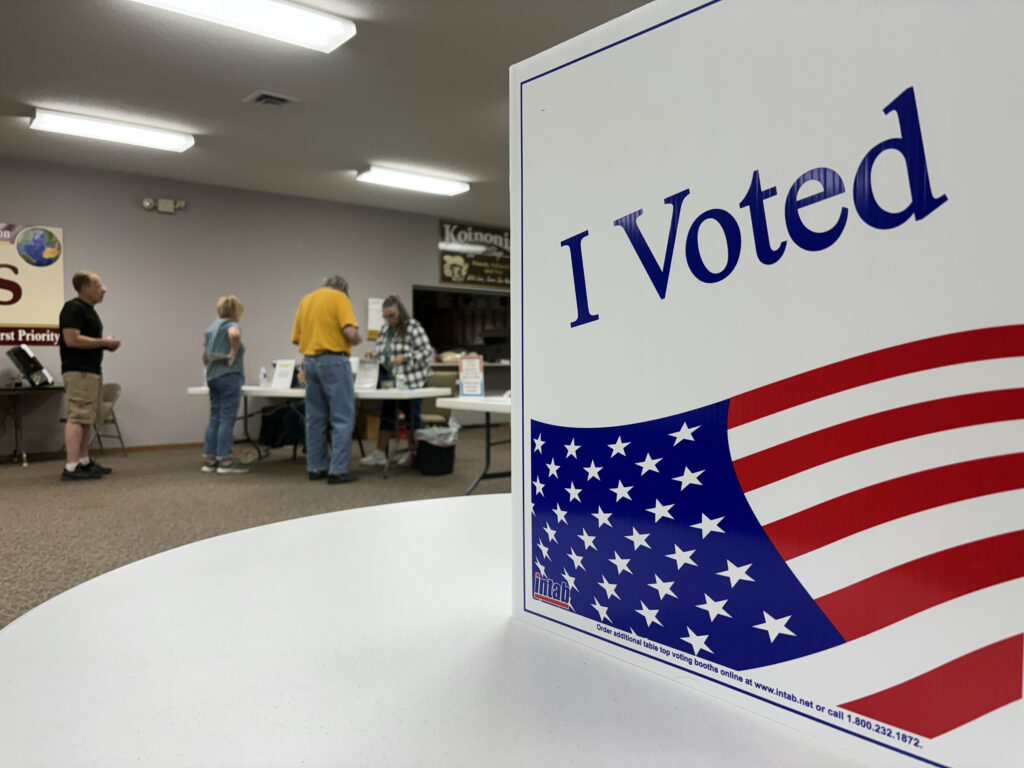
Editor’s note: As part of joint Brookings Radio and Brookings Beacon election coverage, Brookings Radio News Director Jay Roe and Beacon Managing Editor Josh Linehan sat down with Brookings City Clerk Bonnie Foster and Brookings County Finance Specialist Jenna Baker to discuss the Nov. 3 election. The transcript has been edited for style and space restraints.
Jay Roe: What is the city county cooperative agreement for this November’s election?
Jenna Baker: House Bill 1130 went into effect, which basically stated that the city and school elections now must either go on to the June or November… So, the city of Brookings and the Brookings School District both wanted to combine with the county. We have decided to combine because it makes sense, and really we just have a very good collaborative working relationship.
Bonnie Foster: So the cost sharing aspect of the election is where there’s a 25% of the overall cost will be paid by county and then by city, but then the remaining 75% will be divided between the two entities because there’s certain aspects of an election which occur no matter what.
Jay Roe: That’s great to see some collaboration. The process for new voter registration has changed. Can you walk us through what happens when we register?
Jenna Baker: Senate Bill 175 did pass, which now requires newly registered voters or voters that have been removed from the state rolls for whatever reason. If you’re in one of those categories, you now have to prove your citizenship. You either have to provide a photocopy of your birth certificate, U.S. passport, or you can present to our office. You got to show it physically your photo ID, but the issue date has to be July 2025 or after. So otherwise, if you’re already on the rolls, you’re basically grandfathered in. I’ve sent letters to all of our federal only voters, letting them know, this is where you’re at, and if you want to vote in state and local elections, you need to provide proof of citizenship by the deadline, which is Oct. 19.
Josh Linehan: How many elections do you have to miss in South Dakota before you get removed?
Jenna Baker: After four consecutive general elections, or 8 consecutive years, if you do not vote or update your voter registration, or do some sort of activity, you are then moved into an inactive status.You can still vote, but you have to update your voter registration when you do go to vote. And these and these folks do get sent letters and that sort of thing. We do everything that we can to make them aware that they’re about to be removed.
Josh Linehan: And then if somebody gets a letter from you, what should they do, and what do they need to bring?
Jenna Baker: The letter is very specific to what they need to do. You either come in with your photo ID and present it to me, but again, the issue date has to be July 1, 2025 or later. Option two is to provide me a photocopy of your passport or birth certificate or something like that.
Jay Roe: How does absentee early voting work, both in person and through the mail?
Bonnie Foster: Early absentee voting starts Sept. 18. First floor of the city county government building. It’s going to be open Monday through Friday, eight to five. Absentee voting will be open through Nov. 2. Please bring your photo ID. Bring your cheat sheet so you know how to mark the ballot; it’ll speed up the process for you.
Jenna Baker: It is a very lengthy ballot. We will have sample ballots ready, but if you’re not ready to vote in person and you would rather take that ballot home with you, or if you want us to mail the ballot to you, you just have to basically write a written request. If you would rather view your ballot online ahead of time just go to the Secretary of State’s website. It’s www.sdsos.gov.
Josh Linehan: Can you run through who is on the ballot this fall in Brookings and what all we are voting for?
Jenna Baker: The races are going to include U.S. Sen., U.S. Rep., governor, lieutenant governor, secretary of state, attorney general, state auditor, state treasurer, commissioner of school and public lands, public utilities commissioner, senator or state senator, district seven and an eight race, state representative district seven and a district eight race, county finance officer, sheriff, county commissioner, and a city council race. And then on top of all of that, there will be four Constitutional amendments. So that’ll all be on the back of the ballot.
Bonnie Foster: For residents of the city of Brookings, we’ve got the city council race. So we have two seats that are up for election this year. They are for three-year terms. We have five candidates. We’ve got Shawn Hostler, Al Austreim, Wade Wantoch, Lisa Hager and Brianna Doran. And those are both three year terms.
Jay Roe: Where are the voting centers? And can you choose to just go to any one of them?
Jenna Baker: Correct. Brookings County uses vote centers, which allows any voter to go to any of the polling locations. We’ve got the Brookings Activity Center, and then we’ve got Bethel Baptist Church. And in the church, we hold a vote center in the gym, and another vote center in the cafeteria. We also have the Holy Life Tabernacle, and then we’ve got one in each of the small towns. So we’ve got one in Aurora, which is at the Impact Church, the Elkton Community Center, the White McKnight Hall, the Bruce Community Club and the Volga Community Center.
Josh Linehan: What do folks need to bring with them on election day?
Jenna Baker: Bring your photo ID and bring your sample ballot. Those would be the two things because, like I said, it’s a very lengthy ballot.
Josh Linehan: What is the process for someone getting a provisional ballot or requesting a provisional ballot?
Jenna Baker: If somebody comes in to vote and they’re not on the registration list, the poll worker will call us, and we’ll do some research to see maybe why they’re not showing up on the list. I’ll probably ask that voter when did you last vote. But instead of just turning them away completely, we always offer them a provisional ballot. It’s a ballot, but it’s not counted on election night. We hold it separately, and then our office does more investigation to see if it should have been counted. And then after the election’s over, I will send that voter a letter letting them know that either we counted it, or we didn’t count it for whatever reason.
Josh Linehan: It sounds like it’s going to be a lengthy ballot. People should probably have a plan to vote and look at the ballot before they get there on election day.
Jenna Baker: Yes, that way they’re prepared. The more that they can be prepared, the better. And we’re gonna do everything in our power to make sure they’re prepared.
Jay Roe: Some of the unsung heroes of election night everywhere in America are the poll workers. Could you talk a little bit about the role of poll workers?
Bonnie Foster: Here in Brookings and Brookings County, we have some of the best poll workers. We have poll workers that have worked decades for elections for either the city or the county in all of our locations. They’re all trained, and they’re all just very positive individuals, and they understand the importance of our elections, and they just have the highest personal ethics and integrity for working our elections.
Josh Linehan: So there has been plenty of noise about voting irregularities. Can you guys just talk a little bit about Brookings County, Brookings City, and how safe and secure the elections actually are.
Jenna Baker: That’s a great question. We test everything prior to doing anything. We test everything, and then now after the elections, we do a post-election audit, which audits the tabulator. And it has always been spot on. We basically have to go by statute and administrative rule, and it’s very specific on how we have to do things, what needs to be completed, and then it really comes down to us training our election workers. And if anybody wants to take a look at it, they can see the flow of what everything is.
Bonnie Foster: I think people know in South Dakota our elections are really secure. We have good processes both internally and then through the state. That’s filled with checks and balances, and a lot of us, like here in the city of Brookings and Brookings County, we do some internal auditing as well as we go through the process. And as a voter coming to the polls on election day or even early absentee voting, there’s all sorts of things we do to ensure that they have every opportunity to cast their ballot. No one’s turned away for just any reason.
Jay Roe: And looking at the past, we have not had significant voter intimidation or election fraud problems in Brookings County. Is that correct?
Jenna Baker: I think people sometimes forget that they voted. I mean, you also have to remember the general election and the primary election are for 46 days, and so if somebody votes right away, and then how many weeks go past, and they go on election day. So I think people — they just do it by mistake. But we have practices and safeguards in place that we will catch you if you do try to vote twice, and just for the voter to know — voting twice is a crime.We will do everything we can on the back end of things, and we will catch you. So don’t try it.
Josh Linehan: I think it’s important for people to understand: The provisional ballots are part of that whole system. They get a provisional ballot and then it’s sorted out later. The other thing I wanted to ask: What are the rules for polling places and what you can wear or be carrying near a polling place.
Jenna Baker: Yeah, that’s a great point. I wanted to mention this too because absentee voting does start Sept. 18, so there is no campaigning, and that is state law. So there is no campaigning within 100 feet of the entrances. Once we start absentee voting at the city county building, if you have political decals on your vehicles, just make sure that you are 100 feet away, and if you forget, it’s okay because I’ll come find you in the building and tell you to go move your vehicle. I’ve had to do that before. It’s the same for all the polling locations. And it does happen. People have a hat on, T-shirts. My workers just politely tell the person to just take it off or turn it around before they go and vote, and everyone’s been very nice to them.
Bonnie Foster: Just a good reminder. Please don’t come wearing any sort of political campaign materials. We will ask you to leave, remove it and then come back and vote.
Jay Roe: You’ve touched a little bit on this already, but what happens on election day after the polls close? We’re talking the tabulation process.
Jenna Baker: This is the fun part, I guess, for all of us. So typically, we’ve got some workers that are in the garage waiting, and once the polls close, they all pack up their supplies and then my superintendent, one is a Republican and then one Democrat, they basically transport that sealed ballot box back to the building along with all of their election supplies and forms. We help them unload everything, and then one of our temporary election workers walks up with the superintendent and the Democratic worker, and they bring the ballot box up, and they open up the ballot box in front of everybody, take them out, jog them, and yeah, you guys have seen the process, and I love I love having the media back in this process. It is really fun to come up and watch the process.
Jenna Baker: I think the younger generation needs to see that and see the process and see that it’s not so daunting. It is fun and we can have fun with it and it’s a serious process, but we can still have fun while we’re doing it.
Jay Roe: We can celebrate democracy.
Josh Linehan: Other than listening to Brookings Radio or reading the Beacon, where and when are election results officially made public?
Jenna Baker: The city’s website. If you are in person, we’ll be posting it there. You guys will be getting out to all the people, and then of course we always upload the results right away to the Secretary of State’s website. So I know people are always looking at that website.
Jay Roe: What do the election canvass and the post-election audit processes look like? What happens then?
Jenna Baker: We are going to be holding the canvass Thursday, Nov. 5, in the chambers at 8:30 a.m.. We’re going to do a joint city council county commission canvas. We’ll go through some statistics of the day and then we’ll declare the results. We’ll go through the recap sheets and they’ll declare the results, sign the sheet, and that’s basically the canvas. And then the post-election audit, which is new for us. It just shows that our tabulator is working and it’s spot on. That will take place Wednesday, Nov. 18, and I think we’re going to do that at 9 a.m. in the chambers, and that’s also a public process. We will draw a vote center to audit, we’ll draw two races to audit and they just go through that vote center and make sure that the tabulator counted it correctly.
Josh Linehan: I know this is a new process, and we’re trying to get the word out. But turnout was not great for the last one. So if you guys want to get on your soapbox and encourage people to get out and vote, here’s your opportunity.
Jenna Baker: I know. I mean, other than going to everybody’s house and dragging them out, I feel like we try to do the best that we can to make it easy and accessible, and just you know, we do what we can to get them to come out. I think the biggest thing is just educating people more, talking about it more, because I generally just think some people, they don’t know when they can go vote, if they are registered. But yes, get out there and vote. We got you a ballot, and just exercise that right.
Bonnie Foster: I’ll add a comment to that. You know, everybody wants their vote to count, and they want to be an impactful voter. Well, remember, your votes that you cast in your local elections and your state elections carry the greatest weight that affect you directly, right away. So, if you want to be that impactful voter, this is a great election to get out and vote. It’ll impact your community, your county, and your state.
Jenna Baker: That’s a really good point, Bonnie. I did hear a lot of voters chit-chatting, after the mayor’s race there in Sioux Falls, we heard so many comments from people, ‘Oh man, that really was close. I guess our vote really does matter.’ you know. I think that kind of excited them a little bit. So yeah, get out there and vote.
Josh Linehan: Even here in Brookings and Brookings County, we’ve had very close races, especially when you’re dealing with the races that are like two seats and five candidates, you know, three seats and five candidates. Like every vote counts a ton. So, to echo what Bonnie said, no vote you cast will count more percentage wise than these local races.
Jay Roe: And bring your kids with you.
Jenna Baker: I always love to see that too, and so do our election workers. And we have little future voter stickers, so it’s fun.