
Shirt pocket du jour
October 6, 2026
Stubble Mulch
By Chuck Cecil
For The Brookings Beacon
Here’s some old facts and figures about our town I hope you’ll find interesting. They are part of my shirt pocket du jour habit because it’s time to empty my pocket and make room for more old and badly scribbled facts and figures I’ll probably stumble upon in future weeks.
********
Medical examinations of State College students in 1932 revealed the tallest freshman enrolled stood six feet, two and one-half inches. The tallest female freshman was five feet, eleven inches. The shortest male was five feet, four inches. The shortest female was four feet, ten inches. Freshman men and women varied in weight from 110 pounds to 269 pounds.
********
A 1943 College payroll listed hourly wages paid to painters, mechanics, janitors and night watchmen. The college’s lone mason, Dave Elith, received 76 cents an hour, and the 25 janitors were paid 44 to 58 cents an hour depending on years of service.
********
During the flu epidemic of WW I, civilian patients were cared for in Brookings’ first city hall, now the old building in the 300 block on the south side of Fourth Street. Most were elderly, cared for by neighbors or family members. One of the patients, a pregnant woman, gave birth to a daughter who was aptly named “Fluella.” Does anyone know more about Fluella? If so, let me know.
********
In 1910, county commissioners rented an automobile for $2.50 to take them to inspect the drainage ditch of Dry Lake west of Brookings.
It marked the first time an automobile was used for county business.
********
An October 1931 news story told of Lake Campbell seining operations that attracted a crowd of about 600. The seining was necessary before ice set in because the 1931 lake depth was just 30 inches. The first pull of the net on the south side of the lake brought in a “great number of fish” with northerns weighing from five to 15 pounds. When the nets reached shore, each observer got a fish to take home. Another 150 whoppers were hauled to Brookings to be distributed to needy families under the auspices of the Salvation Army. A net sweep of the northern end of the lake captured mostly carp.
********
In June of 1930, a count of cars on Main Avenue resulted in this headline “Nearly Million Dollars in Cars on Streets Saturday.” The car count was 1,041, which brought an estimated 4,000 shoppers from distances ranging from 35 to 80 miles away, according to the Brookings Chamber of Commerce.
********
I found this card of thanks in the 1909 Brookings Press: “I desire to thank the friends and neighbors for their cooperation during the illness and death of my late husband, who escaped from me last Friday while eating breakfast. To my friends and all who contributed so willingly toward making the last moments and the funeral a success, I desire to remember most kindly, hoping these lines will find them enjoying the same blessings. I also have a good milch cow and roan gelding horse, 8 years old, which I will sell cheap. God moves in mysterious ways His wonder to perform. He plants his footsteps on the sea and rides upon the storm. Also a black and white shoat cheap. Mary Smith.”
********
Imagine. Christmas is less than 80 days away.
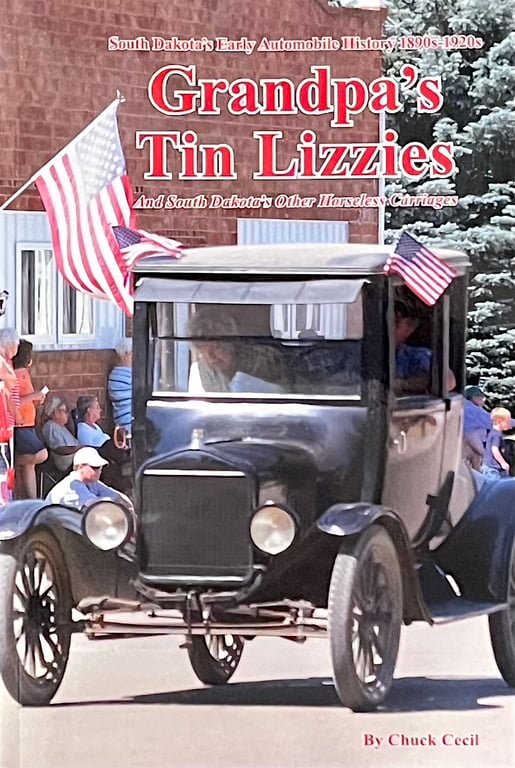
Consider my new book on automobiles in South Dakota from 1890s to the 1920s as a gift. There’s a story in it about the very first historic automobile trip in 1905 from Fort Pierre to the Black Hills by a future South Dakota governor, and another about the two 1908 automobiles named the Silent Sioux and the Fawick Flyer manufactured by a teenage genius in his Sioux Falls factory.
There are many other old car stories, including a full chapter about the reliable Model T Ford, which was by far the most favored brand sought by South Dakotans from its first appearance in 1908 into the 1920s. T
he book also includes 100 pictures of old cars, and the names and hometown of South Dakotans and their machines who were the first residents to receive South Dakota license plates in 1905. “Grandpa’ Tin Lizzies” is available at the Brookings Book Company, Allegra, Ugly Duckling, Pasque and the South Dakota Agricultural Heritage Museum on campus. Or by mail for $25 at Cars, PO Box 872, Brookings.
********
Another Christmas gift idea is my new “Grandpa’s Tractors” book. It tells of South Dakota’s part in the development of the farm tractor, including the two commercially manufactured South Dakota machines. One, the lumbering Dakota Tractor was invented in 1908 and manufactured in DeSmet by a Brookings minister whose church was at the corner of Sixth and Medary. “Grandpa’s Tractors” also includes 75 old tractor pictures and their mechanical details.
The book is also sold at the businesses mentioned above, or by mail for $18 at Tractors, PO Box 872, Brookings.

Stubble Mulch
By Chuck Cecil
For The Brookings Beacon