
Lost WWII pilot found
November 24, 2026
Stubble Mulch
By Chuck Cecil
For The Brookings Beacon
Two Air Force pilot flying P-47 Thunderbolts were on an April 17, 1945, mission near Lonnewitz, Germany.
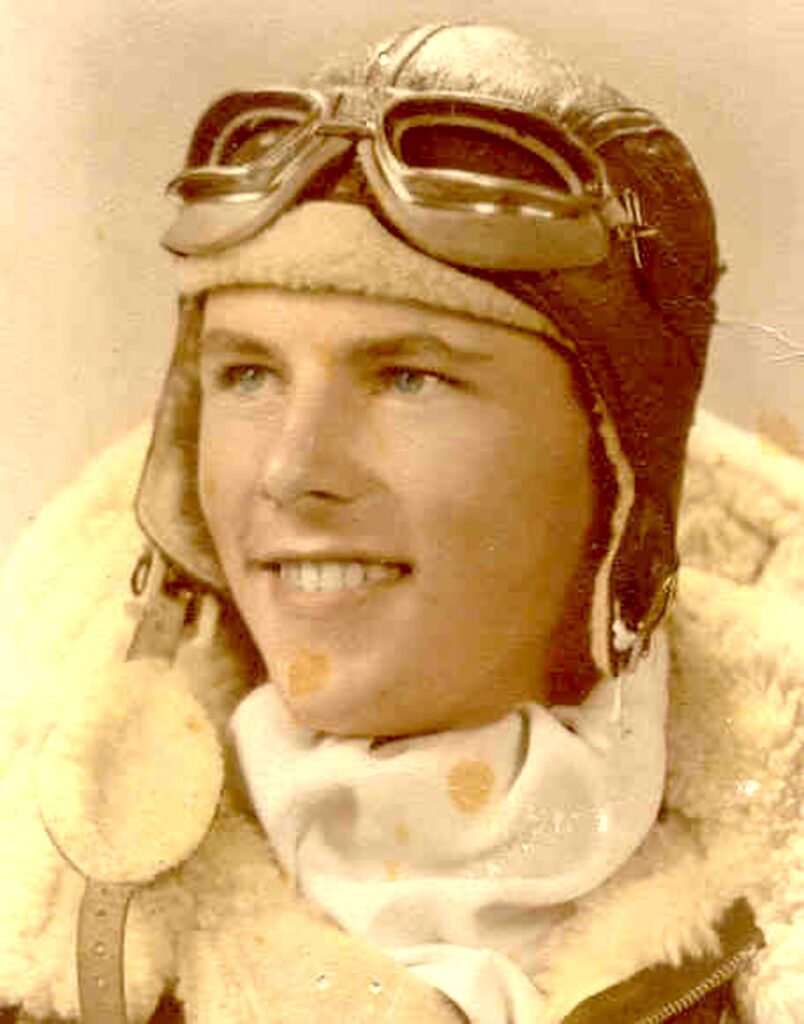
Squadron Leader lst Lt. Hobart Albright and his wingman, Lt. Donald Beals, a 1941 Brookings High School graduate, were looking for targets of opportunity. They hoped to find German aircraft in the air or parked below on grass runways, railroad traffic, German vehicles on the roads, troop emplacements and other war-related equipment or activity.
Their massive, powerful eight-ton Thunderbolts, nicknamed “the Jug” by pilots (because of its milk jug or milk bottle appearance), was the largest single engine fighter plane in WW II. It was loaded for bear, with four .50 caliber machine guns in each wing, each primed with more than 400 rounds of ammo. With that plus bombs under its wings, the “Jug” packed a lethal wallop. It was an ideal WW II fighter plane for-air-to air combat or for ground strafing runs.
Of course, the two Jug pilots flying over Lonnewitz didn’t know the war with Nazi Germany would end on May 8, 1945, just three weeks after their mid-April search and destroy mission.
Cruising at about 5,000 feet, Lt. Beals spotted parked Luftwaffe airplanes below. He radioed squadron leader Albright, who gave the order to dive and attack. As the 22-year-old Brookings pilot winged over and started his descent, German antiaircraft guns opened fire.
Albright, who was maneuvering his Thunderbolt to follow Beals in the low level run, noticed the winking white muzzle discharges of the many Nazi guns firing from below.
“Pull up, Beals,” Lt. Albright radioed. “It isn’t worth it.”
The young Brookings pilot likely never heard the order, or by the time he did, it was too late. His Thunderbolt was struck and barreled into the ground amid a massive roiling, expanding fireball.
Two weeks later, on May 2, 1945, Brookings newspapers carried this item: “Lt. Donald Beals, son of Daniel W. and Clara Eberlain Beals of Brookings, has been reported missing in action in Germany since April 17, according to word received by his parents.”
It would be more than 70 years before the Department of Defense found and identified Lt. Beals’ remains.
All three Beals children served their country during WW II. Donald’s younger brother, Charles, was in the Army, and their daughter, Meryl, was an Army nurse serving in Europe.
In earlier times before the war, the Beals family lived in a stately house at 1302 Sixth Avenue, on the corner of 13th Avenue where today’s First Interstate Bank is part of the 6th Street Centre. At that time, the Beals family owned the land and a greenhouse on the south side of the entire 1300 block of Sixth Street.
In Brooking schools, the Beals children were all excellent students.
After graduation, Don Beals enrolled in the State College mechanical engineering program. But after his freshman year, he decided to enlist in the Air Force with the hope of becoming a fighter pilot.
The wartime loss in Germany of Lt. Beals in April of 1945 was well documented in a series of reports issued by the Department of Defense POW/MIA Accounting Agency, a unit responsible for researching and locating missing service men and women.
Where Lt. Beals and his Thunderbolt fighter went down was never much of a mystery. The crash site was first assumed to have to been found in 1947 by the American Graves Registration Command.
At that assumed site near Lonnewitz, investigators reported finding wreckage and “small fragments of human remains.”
Investigators concluded that the lieutenant’s remains had been “completely disintegrated in the explosion.” The remains were considered “nonrecoverable.” In December of 1949, the Air Force officially declared that Lt. Beals had been killed in action.
In 2004, another investigations team revisited the site, and the puzzle pieces about Lt. Beals’ remains began to align.
Beals’ sister Meryl, the former Army nurse, was subsequently asked by the military to provide a cheek swab—a DNA sample—that officials would entered into a database in the event any remains were ever recovered.
A decade later, in March of 2014, after four archaeological digs at the site, Lt. Beals” remains, along with the parts of his Thunderbolt, and personal belongings, were found and positively identified.
Along with plane wreckage and the lieutenant’s remains, members of the POW/MIA Account Agency found wire-framed sun glasses, an aircrew emblem, coins, a button, boot fragments, a key, comb, pocketknife and other fragments of uniform materials. There was no record his dog tags were recovered.
Fighter Pilot Lt. Don Beals’ remains were returned to the U.S., and on Oct. 17, 2016, and he was buried with honor in Arlington National Cemetery in Washington, D.C.

Stubble Mulch
By Chuck Cecil
For The Brookings Beacon