
Wild turkeys a key part of SD story
November 24, 2026
By Chuck Berry
For The Brookings Beacon
Thanksgiving is a time of family and community togetherness and gratitude.
As I hear the usual thankful prayers, I always listen for some mention of The Creation. After all, we all depend, really depend, on natural resources and our environment. If the thanks-givings don’t mention The Creation, I add silently, but sometimes aloud, “Thanks for the good Earth that God has given us and the wisdom and will to conserve it.”
After this spiritual thought, I admit that my next thoughts turn to the Thanksgiving meal — it is the only holiday where we eat the mascot! But I think of the wild turkey, not the butterball. The wild turkey is the subject of a big chapter in South Dakota’s wildlife history book.
The wild turkey is native to most of North America. It was one of the wild animals that pioneers and settlers hunted for food and commerce. Our nation’s founders briefly debated its merits as a national symbol instead of the Bald Eagle. According to the National Wildlife Federation, Ben Franklin argued that the turkey was “a respectable bird, a bird of courage that would not hesitate to attack a British soldier who invaded the farm yard.” However, in comparison to the mighty Bald Eagle, Franklin conceded that the turkey was “a little vain and silly.” He must have been thinking of the strutting and gobbling and feather displays of the Tom.
Our nation grew, but the turkey population didn’t. As happened to most wildlife, unregulated substance hunting, market hunting and habitat loss caused its demise. Turkeys roost in trees and the timber harvest and deforestation of eastern states is well documented. Market hunters used traps, baits and guns to supply meat markets and restaurants. New refrigerated railroad cars allowed year-round market hunting in the late 1800s.
The wild turkey disappeared entirely in South Dakota by 1920, so wrote Dr. Les Flake of SDSU, in his book titled The Wild Turkey of South Dakota (2006), Dr Flake (and coauthors) wrote “…by 1920, no wild turkeys existed in South Dakota.
Consequently, all populations of wild turkeys in South Dakota today are the result of introductions.” Restoring the wild turkey is one of the great success stories of wildlife science and management. The restoration efforts benefited greatly from the support of a hunter advocacy group – the National Wild Turkey Federation (founded in 1973).
At first, wildlifers tried to raise turkeys in pens and stock them into the wild. However, these captive-reared birds lacked the survival instincts needed to establish self-sustaining populations. So, conservationists tried trapping wild turkeys and releasing them elsewhere, called “trap and transfer.” South Dakota also traded birds with other states – their turkeys for our pheasants and sage grouse. Our first release was eight birds from New Mexico in 1948. But there was more to learn to make trap and transfer a success.
(Stay with me) There are three major subspecies (Eastern, Merriam’s, Rio Grande) of turkeys in North America; their ranges overlap in South Dakota.
The science literature is flush
with genetic analysis, but the upshot is that each subspecies likes a certain type of habitat. Dr Flake and his graduate students, supported by GFP funds and personnel, researched details of turkey ecology and trap and transfer. Today the state supports a robust population of two subspecies, the thriving Merriam’s populations in the Black Hills and the Eastern strain in East River counties.
Turkeys were first stocked in Brookings County around Oak Lake in 1992, and again in 2002 in Oakwood Lakes State Park. Today, seeing wild turkeys is fairly common.
I frequently have to slow down to let a flock cross from field to roost along 469 Street South near Lake Campbell.
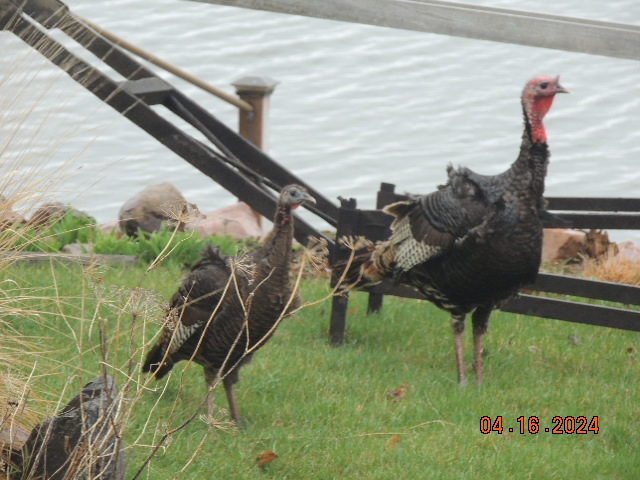
The bird: Males older than 2 years are called “toms;” the younger males are “jakes.” Both gobble to attract a hen or warn other males. An adult gobbler weighs 16 to 22 pounds, has spurs for fighting, a beard of modified breast feathers, and that iconic fan of tail feathers. A hen is smaller and has no beard or spurs. Turkeys can run at speeds of up to 25 mph and fly as fast as 55 mph. Baby turkeys, called poults, eat berries, seeds, leaves and insects, as do adults.
The hunter: Most hunters use a hen decoy and a turkey call while sitting very still in camouflage clothes. Calling is an art form; you need to know turkey language and the meaning of a yelp, cluck, purr, cutt, kee-kee, and putt. Hunters use shotguns, so the quarry has to be close, and even closer if the hunter really challenges themselves by archery hunting, about 9% do so.
I heard about an unusual turkey hunting technique when I interviewed Jackrabbit footballer Brayden Delahoyde (#10) from Spearfish. Brayden said that he really likes “creeping” turkeys. He explained that turkey creeping is when a hunter stalks a tom turkey by crawling toward it while hiding behind a turkey decoy. They hope to trigger an aggressive charge from a mature male gobbler. Now, that’s hunting close and personal!
The hunting season: South Dakota has gobbler-only turkey hunting seasons in spring and fall. The harvest is closely managed by limiting the number of hunters and days. Some licenses are reserved for landowners. Hunters apply for a specific hunting area. Brookings County is Unit 06A on the map. In Brookings County, last year, seven landowners and 13 resident hunters received tags, compared to hundreds of tags issued for some Black Hills hunting units.
As I looked over the turkey decoys at Runnings, two turkey-hunting salesmen (both SDSU students) said that the spring season is the most popular because that’s when the gobblers are most active, and outdoors enthusiasts want to get out there! Indeed, license sales agree. Of the 22,000 licenses sold, 90% were for the spring season. South Dakota turkey hunters generate about $20 million annually (the figure is $300 million for pheasant hunting). The GFP gets youth interested by offering “mentored” hunts, where an unarmed adult accompanies a youth hunter at least 15 years-old. About 2,000 mentored turkey hunting licenses are sold annually.
The meal: Wild turkeys are leaner and tougher than store-bought. Cooking the whole bird usually begins with brining to tenderize and add moisture, then slow roasting while basting with butter or oil. One turkey hunter at Runnings said “I don’t have time for all of that, I cut the breast into nuggets, coated with shore lunch (a fish batter) and fried them up.”
Whatever turkey is on your table this Thanksgiving, I say eat up! The Bible says “Go, eat your food with gladness, and drink your wine with a joyful heart, for God has already approved what you do.” (Eccl. 9:7).
I’d like to suggest a couple of practical ways to practice Creation Care. Reduce food waste, buy locally grown produce, and use real cloth and silverware, or use compostable table settings and trash bags. Take a Thanksgiving walk or drive to connect with nature. Finally, say a table grace that ends in “Thanks for the good Earth that God has given us and the wisdom and will to conserve it.”

By Chuck Berry
For The Brookings Beacon