
Tracking down one of our first WWII vets
November 11, 2026
Stubble Mulch
By Chuck Cecil
For The Brookings Beacon
Today is Veterans Day.
I have a veteran's story to tell you.
I was searching for Sheldon Coe, who grew up in Brookings living with his grandparents, the C.A. Skinners, in the stately house still at 824 Fifth Street.
I hoped to find Sheldon Coe, and if successful, include his WW II story in a book I was writing about life in Brookings during WW II, and about the county men and women who were off fighting the worldís most destructive, deadly war ever.
Sheldon Coe's grandfather, C.A. Skinner, was an early Brookings businessman and civic leader. In the late 1890s he built what is today the New Century Building located today in the northeast quadrant of the Main Avenue and Third Street intersection.
The Skinners' daughter, for personal reasons, decided to have her parents raise her only son Sheldon, which they agreed to do. Sheldon grew up in Brookings and graduated from Brookings High School in 1935 and majored in chemistry at State College.
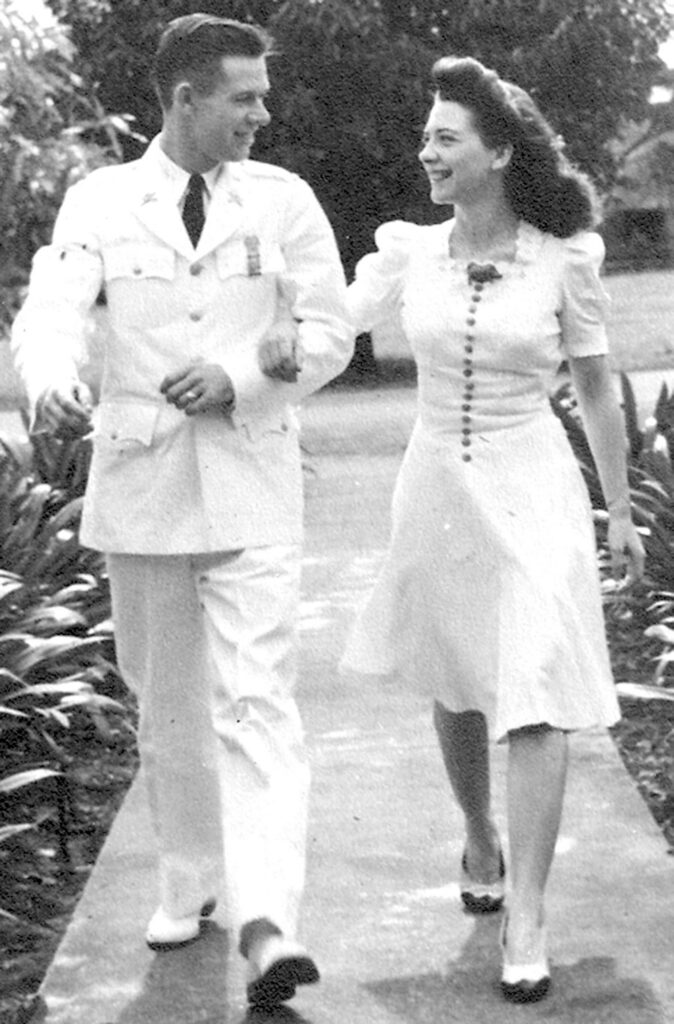
He graduated from State in 1939, as did his future wife Valeria, who was from Rapid City.
While in college, Sheldon Coe enrolled in the Reserve Officers' Training Corps (ROTC) and was commissioned a 2nd Lieutenant before the start of WW II. He was assigned to the Philippines and was there on Dec. 7, 1941, when the Japanese attacked the huge U.S. naval base at Pearl Harbor, Hawaii.
Coe was slightly wounded in a bombing attack on the American airbase, Clark Field, in the Philippines and became the first Brookings service man to be wounded in WW II.
Shortly thereafter, having recovered from him wound, he was assigned to serve with Philippine troops on the Bataan Peninsula. There, he was one of about 70,000 Filipino and American soldiers captured by the Japanese, who had invaded the islands on Dec.8, 1941, a day after the Pearl Harbor attack. After being taken prisoner, Sheldon Coe survived the infamous Bataan Death March and spent nearly all of WW II years as a Japanese prisoner of war, first in the Philippines and later, as a slave laborer in a Japanese coal mine in China.
Because Sheldon was the first soldier from our little city to be wounded in WW II, I decided to set out to find him and learn more of his WW II experiences.
I frankly didnít expect to ever find the man. Where were he and his wife Valeria now? Were they even alive? Probably not. Perhaps some of their children or grandchildren still lived in the Vero Beach area, which was the Coe's last known address.
I emailed a Vero Beach newspaper columnist and explained my plight. I ask if in one of his columns he could mention Sheldon Coe. Perhaps a friend or relative reading it would respond.
The columnist e-mailed back to me. A Sheldon Coe was listed in the Vero Beach phone book. I called the number. A man answered. From the youthful sound of his voice, I thought Iíd found a grandson or perhaps a great grandson.
I explained why I was calling and asked if I was speaking to one of Sheldon's grandsons. "No," the voice answered, "I'm Sheldon Coe. I'm 94 years old." I was elated. I asked if talking about his war experiences would upset him. He said it wouldn't.
I visited with him on the phone, and later talked with his wife Valeria, also 94. We had something in common. She was also a graduate of Rapid City High School. She told me Sheldon wasn't doing well. His memory was fading. But over the next three weeks, the three of us discussed his incredible WW II story.
Valeria said that from the time American dependents of servicemen in Philippines were sent back to the United States before WW II started, she lost contact with her husband and did not learn until late 1944 that he had survived the Japanese invasion of the Philippines and was a prisoner of war.
Coincidently, by Dec. 13, 1944, Americans and allies were attempting to recapture the islands. Coe and more than 1,600 Americans and other allied prisoners during the invasion were secretly packed in the hold of a Japanese cargo ship, the Oryoku Maru (it and others like it were called "hell ships)" for what became a 43-day war-time journey to Japan. It was a horrible experience, described after the war as one of the most tragic "friendly fire" incidents of the war.
Here's why.
Coe and other American prisoners were crammed into the sweltering, unventilated cargo hold of the Oryoku Maru. A few pails of food and water were lowered into the shipís hold each day, but sufficient food and water were almost non-existent. Men went mad. Others silently died in the human filth and stifling heat, but those conditions were just part of the misery.
Attacks on the ship by American fighters and bombers commenced even before the Oryoku Maru was out of its Subic Bay harbor. In those Dec. 14 and 15 attacks, American pilots were unaware of the hell ship's cargo and bombed and strafed the Oryoku Maru, killing and wounding several hundred prisoners on the ship. As the Oryoku limped back to port in Subic Bay, many prisoners attempted to escape by jumping overboard and swimming to nearby land. Many were shot by the Japanese and others were recaptured.
Surviving and recaptured prisoners were transferred to another hell ship, the Enoura Maru, before the damaged Oryoku Maru sunk while moored in the Subic Bay harbor.
The Enoura Maru, which now held approximately 1,300 surviving Americans and allies of the initial 1,600 prisoners on board, made a second attempt to leave Subic Bay for Japan. It, too, was attack by American bomber and fighter planes and the prisoners had to once again leave their bomb-damaged vessels that had managed to limp into a port on the island of Formosa midway between the Philippines and Japan.
U.S, aircraft continued to attack the ship as it sailed for Japan.
When it arrived in Japan, Sheldon Coe was among just 128 surviving prisoners, the rest having died in the air attacks, killed by Japanese guards or who had died of starvation and other causes.
From Japan, Coe was sent to Manchuria, China, to do slave labor in a Japanese coal mine there. He was liberated in 1945 from the Manchurian prison by the Russian Army. As an indication of the harsh treatment and little food he received as a prisoner, he had lost more than 50 pounds and weighed just 115 pounds. After the war ended, Coe eventually returned to his grandfatherís house at 824 Fifth Street, Brookings, and to his waiting wife, Valeria.
If you drive by Coe's grandparents Brookings Fifth Street home today you will notice a rounded room on the upper northeast side of the home. Valeria told me that while she waited her husbandís safe return, she sat for hours in that rounded second story room in silence and prayed the war would end. In that room she wrote long letters to her husband that she could never mail to an unknown prison address in China. She kept the letters for Sheldon to read if and when he returned to her at 824 Fifth Street, Brookings.
After the war and the difficulties that followed, Sheldon and Valeria slowly picked up their lives and raised a family. He became president of the Industrial Display Company, a computer hardware and engineering solutions firm in Indiana. The couple later retired to Vero Beach.
American war hero and survivor Sheldon Coe died there in 2012 and is buried in the Black Hills National Cemetery near Sturgis.

Stubble Mulch
By Chuck Cecil
For The Brookings Beacon