
U.S. wealth inequality needs intervention
November 17, 2026
By Bob Burns
For The Brookings Beacon
Among the many pre-midterm election polls conducted was a June 2026 You Gov poll regarding wealth inequality in the United States.
The poll showed that 53% of those polled believed that the ultrawealthy take more from society than what they contribute and 59% of those polled showed support for federal government policies that would reduce wealth inequality in the United States.
In addition, an October 2026 Pew Research Center poll revealed 61 % of those polled believe there is too much economic inequality in our nation. Voter concern regarding the distribution of wealth in our nation coincides with affordability and corruption being ranked as leading issues.
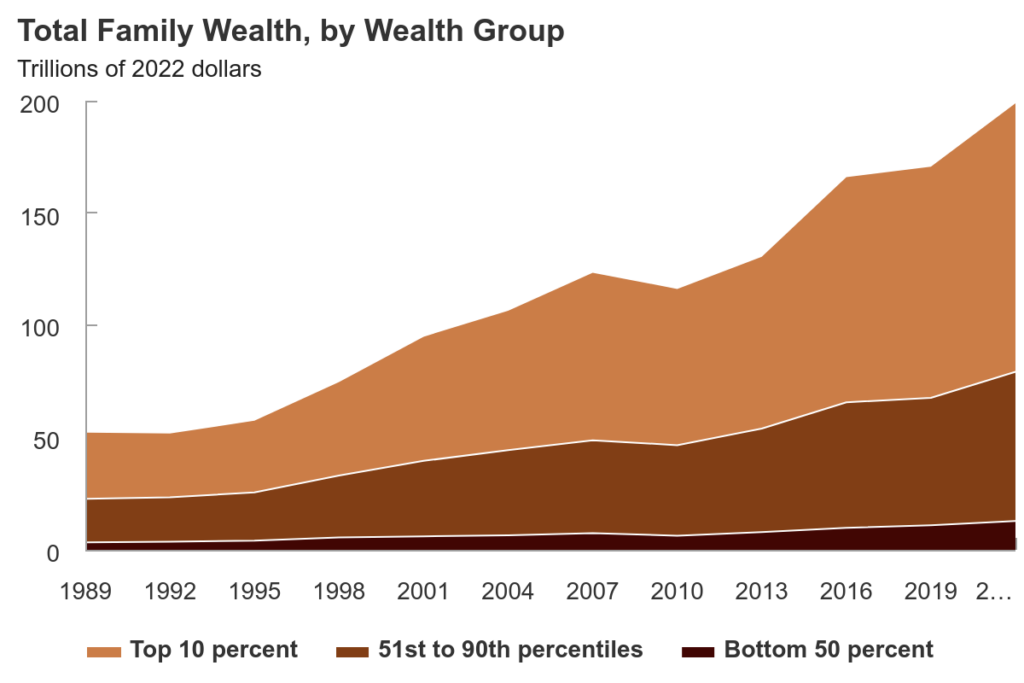
Data tracked and recently released by the Federal Reserve reveal the source of Americans’ concern regarding wealth inequality.
According to the data released, the top 1% of US households own between 31.6 % -32.5% of total household wealth while the entire bottom 50% of households own 2.3%-2.5% of our nation’s wealth.
Also, the top 10% of households possess 88% of all US stocks and hold 65%-85% of total household assets while the bottom 10% experience negative wealth meaning their debts exceed the value of their assets.
The trend toward greater concentration of wealth is increasing as Federal Reserve data reveal that since 2024 the wealthiest 0.1% of American household have gained 8000 times as much wealth per household as the entire bottom 50% of US households.
There are multiple reasons for the growing concentration of wealth in our nation. Among the reasons are the ability of those with excess wealth to generate even more wealth through entrepreneurship, interest and dividend income, capital gains income and rent income while those without surplus wealth are limited to earned wages and salaries.
Favorable estate, trust and inheritance tax laws allow for substantial intergenerational wealth transfer, and other tax laws allow for tax avoidance provisions which favor the wealthy. An economic reward system that frequently fails to reflect an individual’s or group’s contribution to the common good also contributes to wealth inequalities. We find this true today as wage and salary workers receive a smaller percent of corporate earnings while top management and stockholders receive a growing share. Likewise, we read daily of low salaries paid public school teachers who are teaching our children to read and write while professional athletes complain about multimillion dollar contracts.
Americans’ belief in the free enterprise system and the American dream have tempered criticism of wealth inequality for much of our history. We were taught at an early age that if you use your wits to build a better mousetrap, the world will beat a path to your door. You will be financially rewarded for your ingenuity, risk taking and hard work and you will be entitled to enjoy and share your rewards as you desire. A government prescribed economic reward and tax system that takes from the rich and redistributes wealth to the non-rich presents a challenge to our cultivated beliefs.
Perhaps more importantly, those with wealth are in a better position politically to secure the current wealth inequalities than those without wealth are to achieve a redistribution of wealth.
There are multiple economic, political and social consequences of an excess concentration of wealth in our nation and globally.
Economically, consumer spending is less when 50% of US households possess little or no wealth and, as a result, are greatly restricted in their purchasing decisions. Opportunities for entrepreneurship are also restricted for those lacking startup funds and a favorable credit rating.
In addition, human capital development is stifled as too many Americans can not afford quality education or access to quality health care. Social consequences of excess wealth concentration are found in stagnant social mobility, erosion of social cohesion within a nation and wealth based residential and education segregation. Finally, political consequences of substantial wealth inequities are increasingly obvious to us. The ultrawealthy enjoy greater access to our decision makers because of financial campaign support provided candidates of both parties. Inequalities in the distribution of wealth cause millions to lose trust in democracy and contribute to polarization and populist movements, all of which challenge the stability of democratic nation states.
Polling mentioned at the start of this column may be evidence that American voters desire new government policies that might lessen the great concentration of wealth and redistribute more wealth to more households. The huge number of Americans who feel left out may be able to overcome the political advantage enjoyed by the very wealthy. Labor reform legislation could lead to more labor unionization, increase in the federal minimum wage to $15 per hour and improved benefits. Education and healthcare reform could lead to better development of human capital. Tax reform could undo the carried interest loophole and other tax deductions and credits that primarily benefit the wealthy.
Changes in estate, trust and inheritance tax law could reduce the level of intergenerational wealth transfers. The highest marginal IRS tax rate is 37% compared to 90% immediately following WWII and 70% at the start of the Reagan Administration in 1981. During the Reagan years, the Democrats agreed with Republicans to lower the marginal rates in exchange for the elimination of countless tax avoidance provisions. Since then, the marginal rates agreed to remain unchanged but countless tax avoidance provisions favoring the wealthy have been restored. Repeal of tax provisions favoring the wealthy will lead to increased government revenue which can be directed to other reforms impacting wealth distribution. For example, an improvement in the safety net for low-income Americans might provide the added opportunity needed for more Americans to pursue new aspirational goals.
Nothing I have written imagines a perfectly equal distribution of wealth. What I do imagine is a fairer distribution of wealth that might resolve the current economic, social and political issues that find their origin in the substantial concentration of wealth that currently exists in our nation. In the end, we will all benefit from a more viable and stable economic, social and political order.

By Bob Burns
For The Brookings Beacon