
Army’s ‘typical Ranger’ Evans
November 17, 2026
Stubble Mulch
By Chuck Cecil
For The Brookings Beacon
In late 1938, Warren Evans, a three-sport athlete from Aberdeen, was recruited by South Dakota State College for his football, basketball and baseball talents.
As a freshman at State, Evans’ leadership qualities stood out. He was elected Freshman class president, and his excellent singing voice earned him a in the college choir.
Athletic scholarships then were a fraction of what colleges today dole out to attract good players. Evans probably had part of his tuition paid for, but little else. To help make ends meet while in college, the 20-year-old also signed up with the Brookings National Guard unit.
This was while the dark clouds of war were wafting slowly toward what became WW II, and while Evans made it through his freshman year in Brookings, his college years ran out.
During the summer after his freshman year, the government called his National Guard unit to active duty. Evans dropped out of college and left for training at Camp Claiborne, La. After several months there, the Brookings contingent was sent to Ireland. While there, Evans learned the Army was organizing a special fighting force patterned after the British Commandos.
He volunteered for that lean, ultra-motivated, elite group known as the Rangers. That decision changed his life forever.
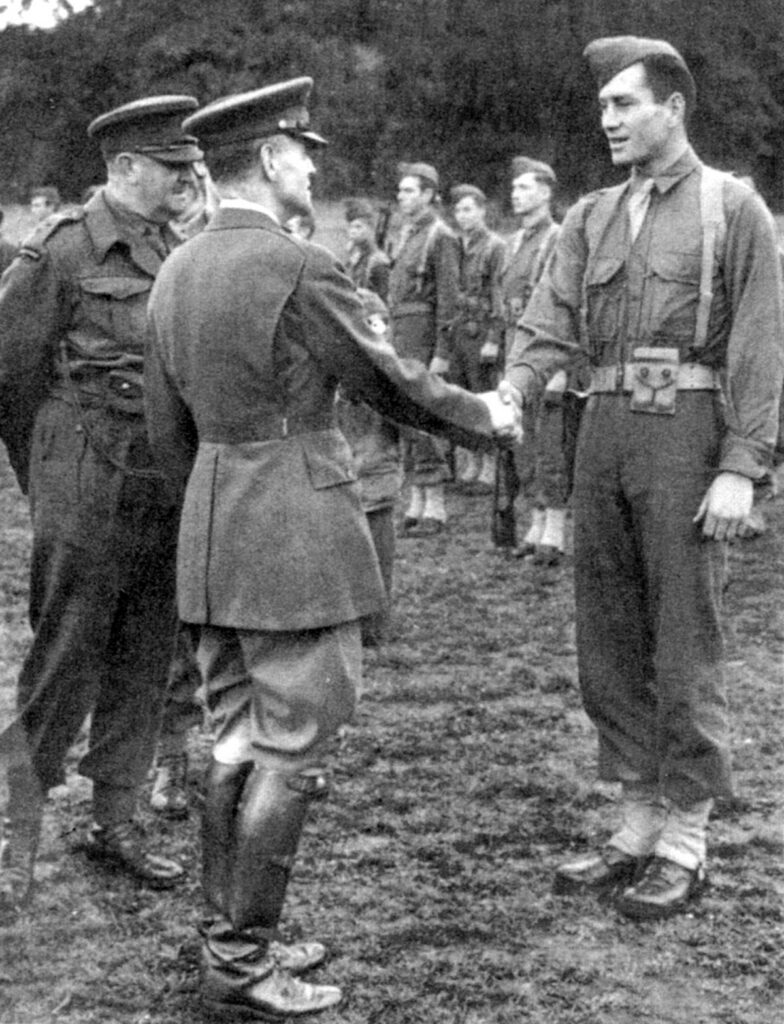
He was a perfect Ranger fit and did well in his new-found challenge. Evans was among the first 2,000 men volunteering for the unit. Only about 500 in that group, including Evans, were selected for further Ranger training. In August of 1942 he was named the nation’s “typical Army Ranger.” His story and pictures of the tall, muscular, handsome young man from Aberdeen were distributed to national newspapers and magazines and appeared in newsreels then shown at local theaters throughout the nation. A photo of Evans also was published in the New York Times Sunday magazine and in the popular Life magazine, which at the time had nearly three million subscribers.
After further Ranger training in England, his Ranger unit and others were soon off to battle, participating in the raid at Dieppe, the North African invasion, and in the battles of Tunisia, Sicily, and Salerno. For his leadership in those battles, Evans received a battlefield promotion to captain and became leader of a Ranger company. It was after those battles that Capt. Evans and his troop took part in the rugged combat that begin on the beaches of Anzio, Italy.
His group was assigned to infiltrate at night behind German lines and to occupy the town of Cisterna which was five miles inland from the invasion landing beaches. It should be noted that after WW II, Evans exploits were written about in a book, “Heroes Cry Too.” In that book, Evans remembers that dangerous night-time infiltration of German lines in Italy.
“I knew we were on a suicide mission,” he said in the book. “Sure enough, just a couple of hours later we ran into a buzz saw.” He remembered that by noon the next day (January 30, 1944), “we were wiped out.” His unit was surrounded, nearly out of ammunition and many of his men were dying. Evans was also wounded during that ill-fated night assault when a mortar round exploded near him.
“I’ve been told there was an explosion of some kind,” he said in his book. “I don’t remember the explosion, and I’ve never been able to remember even hitting the ground,” he said. “But I do remember the ground coming up at me.” He and his fellow-rangers were captured by the Germans, but he had no memory of the next three of many months he was held as a POW.
The Germans first moved the battle’s prisoners to Rome. Evans didn’t remember that move, but he and the other prisoners were made to take part in a three-hour long Nazi victory parade past the famed coliseum and through the streets of Rome. The Nazi’s filmed that parade for propaganda purposes. It showed parade watchers lining the parade route spitting on, throwing rocks at and physically attacking the American prisoners as they marched by.
Eventually, the surviving officers captured at that Anzio battle ended up in a POW camp in Szubin in German-occupied Poland. Evans recovered from his battle wound and tried to escape from Szubin three times. After his third unsuccessful attempt, the Nazis sentenced him to death by firing squad. The date set for his execution by firing squad was April 22, 1945.
But with friendly Russian troops approaching Szubin as war’s end neared, Evans was among nearly 1,500 American POWs prisoners who were escorted by German troops marching to other POW camps ahead of the advancing Russians.
Unfortunately, the first several days long march took place during a brutal blizzard which started on January 21, 1945. The POWs, with little food or proper cold weather clothing, were eventually rescued near the Elbe River after a long, arduous march of more than 300 miles.
After VE-Day, America’s “typical Army Ranger” quietly returned to Brookings without fanfare, which was common in those days. Back in Brookings, Evans married his college sweetheart, Frances Wheeler of rural Fountain, a small farming community northeast of Brookings.
They settled in Brookings and Evans teamed up with another returning GI, Al Arndt, to start a sporting goods store at 416 Fifth Street. Arndt, incidentally, played football for State College and in 1935 was drafted by the Pittsburg Steelers professional football team.
Evans, whose nickname at State College that followed him into the Army was “Bing,” apparently because of his Bing Crosby-sounding singing voice. (Entertainer and movie star Bing Crosby was famous world-wide for his vocal talents.) Evans was popular and active in the Brookings community and helped other members of the Brookings Chamber of Commerce stage a 1947 musical in which he was the featured singer. At that event he sang “Melancholy Baby” and “Downtown Poker Club.”
A few years later the young couple left Brookings for another business opportunity with the Ralston Purina Company in Huntingburg, IN. They later moved to Portland, OR, to be closer to their children, and that is where the nation’s “typical Army Ranger” died at the age of 96.
He is buried in Brookings’ Greenwood Cemetery.

Stubble Mulch
By Chuck Cecil
For The Brookings Beacon